Why Comfort Is a Serious Choice

There's a version of productivity culture that treats comfort as the enemy. The idea that if you're too warm, too relaxed, too at ease, you won't push. That friction and discomfort are what make work happen. That the people who achieve things do so by making themselves uncomfortable enough to want to escape into productivity.
This is wrong. Not just as a philosophy — empirically, measurably wrong. And the students who understand this have a significant advantage over the ones who don't.
The Myth That Discomfort Makes You Work Harder
The confusion comes from a real phenomenon, badly misapplied. Mild stress — the kind that comes from a deadline, from challenge, from being slightly out of your depth — does sharpen focus. The body's stress response releases hormones that increase alertness and narrow attention. In short bursts, that's useful.
But physical discomfort — being cold, being in an uncomfortable chair, wearing something that doesn't feel right, being in an environment that grates on you — doesn't produce the same effect. It produces distraction. Part of your cognitive bandwidth is permanently occupied managing that discomfort, which means less is available for the actual work. The body treats physical discomfort as a low-grade emergency it can't fully ignore.
The people who consistently do deep, sustained work have generally figured this out. They don't suffer through their environment. They design it.
What Happens When Your Body Is Actually Comfortable
Comfort and productivity aren't opposites. They're conditions. When your body is warm, physically at ease, in an environment that doesn't demand constant micro-adjustment, a particular kind of attention becomes available. The kind that can hold on to a complex idea long enough to understand it. The kind that can stay with a piece of writing long enough to make it right. The kind that can work for three hours without the session feeling like an endurance test.
This is the state students are trying to create when they bundle up in oversized hoodies for study sessions. It's not about looking relaxed or performing a certain aesthetic. It's a functional choice: a body that's warm and physically at ease is a body that can focus.

Building Your Environment Intentionally
Most students inherit their study environment rather than design it. They sit wherever's available, wear whatever they grabbed on the way out, work in rooms that are too bright or too cold or too loud — and then wonder why the session didn't go well.
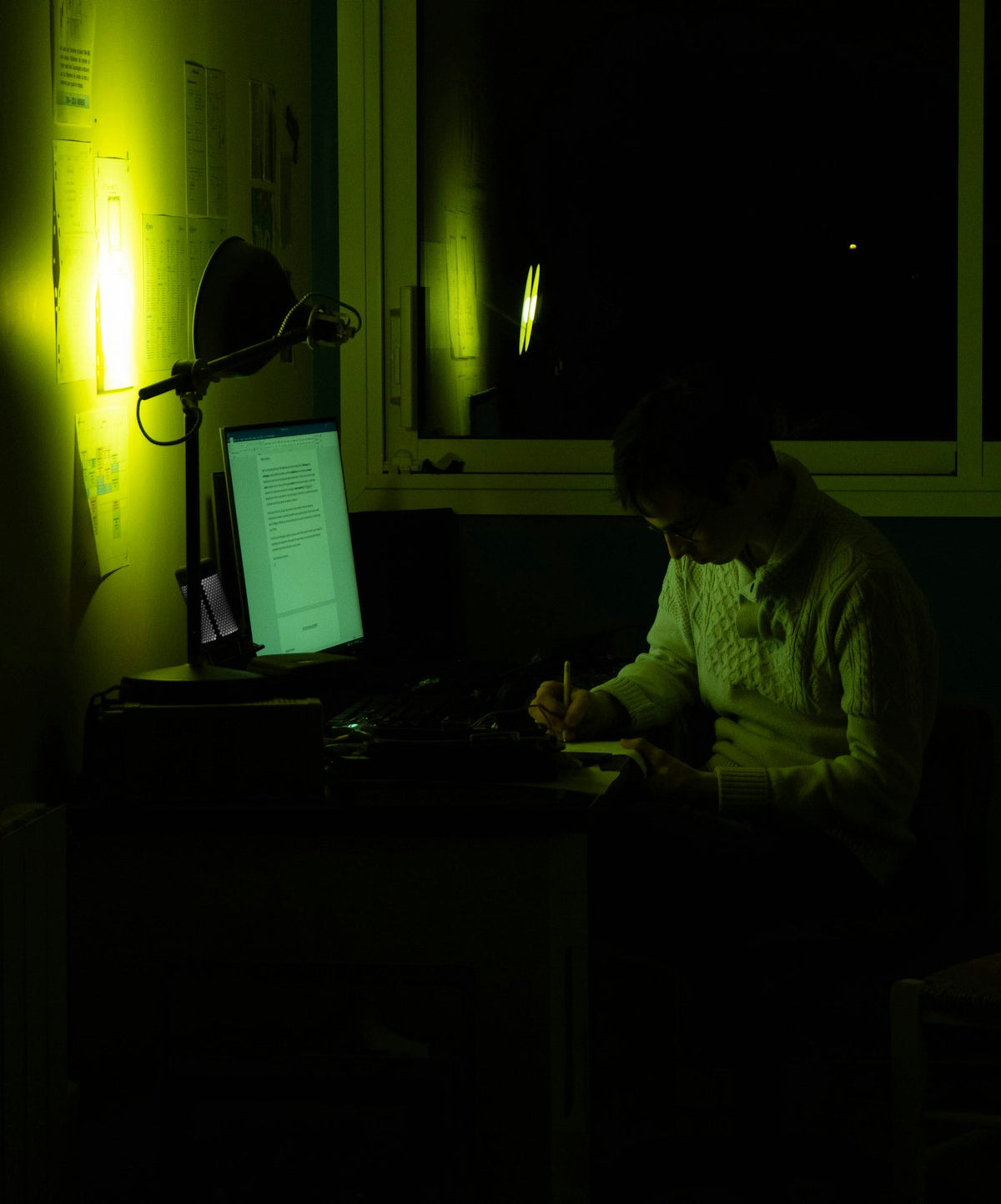
The students who consistently do their best work tend to be slightly obsessive about their environment. Not because they're precious, but because they've noticed the correlation. The same person who struggles to concentrate in a bright, cold, uncomfortable space will work for hours in a dim, warm, quiet one. The variable isn't their motivation. It's the conditions.
Small things compound. A desk lamp instead of overhead lights. A hoodie heavy enough to actually retain warmth — not a thin jersey layer that's more gesture than garment, but midweight brushed fleece that traps a layer of warm air close to your skin. The Hüdíe Eclipse Panel in Cream is designed around exactly this principle: the brushing process raises the interior fibres to trap warmth; the 80% cotton means it breathes rather than sealing in moisture that would make you colder; the relaxed fit sits well in a chair for hours without needing adjustment. The result is a hoodie that keeps you warm enough to focus without becoming a distraction in itself. A chair you can settle into. A playlist you don't have to think about. Each of these is a small act of designing for the person you want to be in that space.
Comfort as a Standard, Not a Reward
The cultural instinct to treat comfort as something earned — something you allow yourself after the work is done — has it backwards. Comfort is what allows the work to happen at all. It's not a reward for focus. It's a precondition for it.
This matters especially at university, where the ambient culture often celebrates suffering — the all-nighter, the skipped meals, the cold flat, the grinding-it-out narrative. These things happen. But they're not the reason the work gets done. The work gets done despite them, not because of them. And the students who learn to make themselves genuinely comfortable before they sit down tend to work longer, with more depth, and with less of the resentment that builds up when you're constantly fighting your own environment.
Comfort is a serious choice. Not a soft one.
Start with what you wear. See the Eclipse Panel in Cream — or browse the full Hudie range.
Imagery: Javier Haro, King Buwa via Unsplash